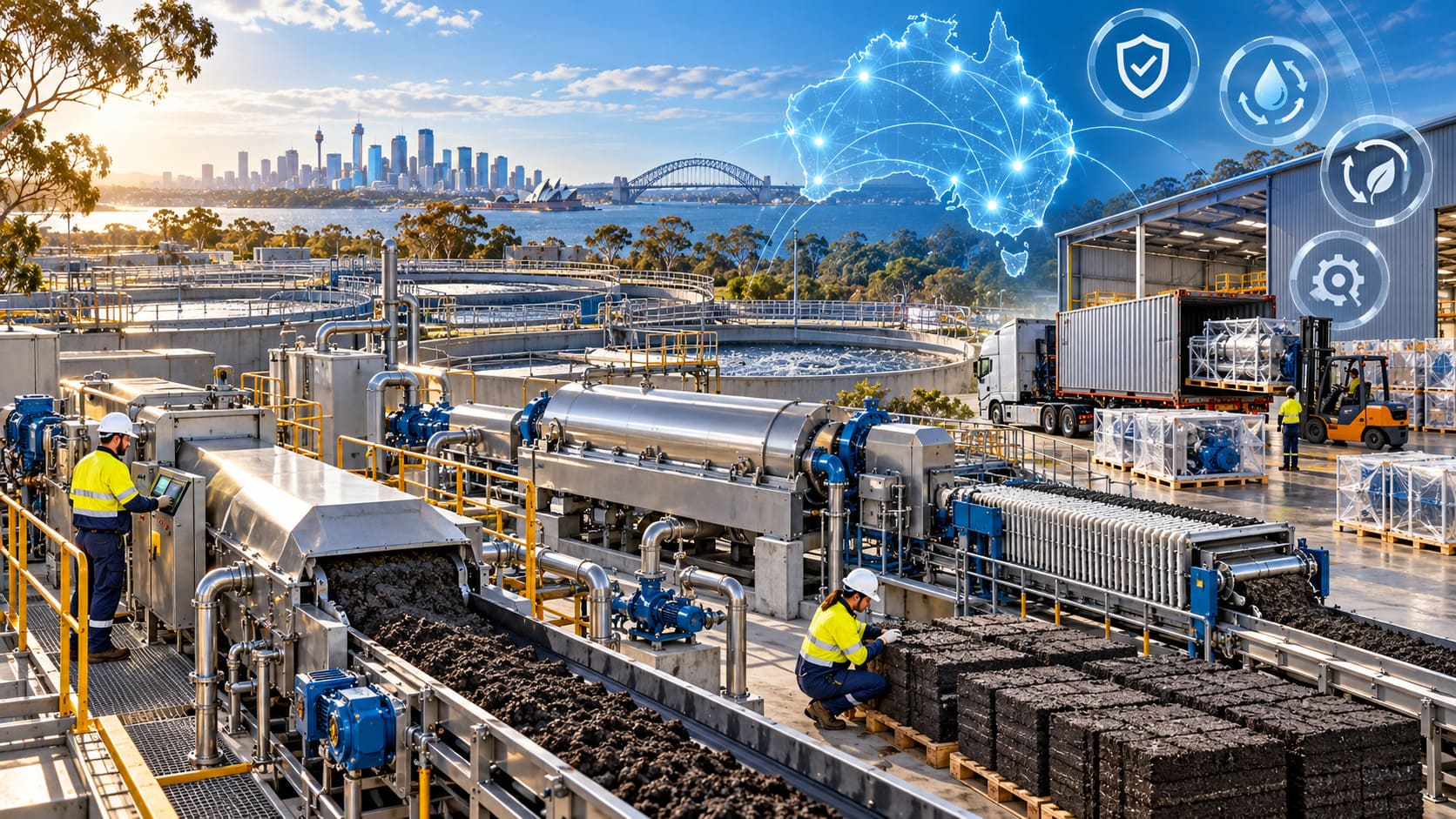
Australia has the clearest dewatering payback maths of any market GreenCarry sells into, and the highest barrier to entry for equipment importers. Those two facts are connected, and for the right local partner they add up to an unusually defensible position.
The payback comes from the waste levy. The barrier comes from the Electrical Equipment Safety System. This article explains both, sets out where the demand sits, and describes what a distributor partnership involves.
Why Australia works: the levy makes the argument for you
Most dewatering sales conversations start by establishing that sludge volume costs money. In Australia, that step is already done — state waste levies have made disposal cost a standing agenda item for every industrial waste generator in the country.
Indicative general and industrial waste levy rates for 2026–27:
| State | Levy rate (general/industrial waste) |
| New South Wales | approx. AUD 180 per tonne (Sydney metropolitan levy area); approx. AUD 104 per tonne (regional levy area) |
| Victoria | approx. AUD 177 per tonne (metropolitan and provincial premises) |
| Queensland | approx. AUD 135 per tonne (metropolitan); approx. AUD 100 per tonne (regional) |
| Western Australia | approx. AUD 90 per tonne |
Rates vary by waste category, levy area and financial year, and should be confirmed against the relevant state EPA for any specific quotation. Sources: NSW EPA waste levy, EPA Victoria waste levy, Queensland levy rates.
These are levy rates only. They sit on top of the gate fee and the haulage cost. A generator in metropolitan Sydney or Melbourne is paying a three-part cost per tonne, and a sludge at 3% solids is 97% water by weight.
Based on the equipment's published input and output ratings, the mass of material leaving site falls by roughly 75–80%. Against a levy alone of AUD 177–180 per tonne in the two largest metropolitan markets, before gate fees and haulage, the payback calculation writes itself — and unlike most markets, the distributor does not have to source the number. The customer already knows it.
Beyond the levy, two further drivers:
Trade waste agreements. Water utilities price trade waste discharge on load, giving generators a direct incentive to manage solids on site rather than send them down the sewer.
Distance. Australia's industry is dispersed, and haulage distances to licensed facilities are long. Transport cost per tonne is higher than in comparable economies, which amplifies the value of volume reduction — and makes low-maintenance equipment more valuable, because a service call to a remote site is expensive.
The EESS barrier, and why it favours the local partner
Australia does not let overseas manufacturers sell electrical equipment into the market directly. That is the single most important structural fact for anyone considering this distributorship, and it is good news for the distributor.
Under the Electrical Equipment Safety System, a "responsible supplier" is the person or legal entity who manufactures in-scope electrical equipment in, or imports it into, Australia or New Zealand — the first supplier in the chain. A responsible supplier must hold an Australian Business Number (or a New Zealand IRD number) and must register in the EESS Registration Database before selling in-scope equipment. Second and subsequent suppliers must source from a registered responsible supplier (EESS).
Equipment is classified into three risk levels. Level 1 requires evidence of compliance with the relevant standards. Level 2 requires evidence plus a compliance folder. Level 3 requires a mandatory Certificate of Conformity. Levels 2 and 3 must be registered. Suppliers must affix the Regulatory Compliance Mark (RCM) in accordance with AS/NZS 4417.1 and AS/NZS 4417.2, and the RCM may only be used on in-scope equipment that complies with EESS.
What this means commercially
CE marking alone is not sufficient for Australia. The equipment is supplied to CE requirements, which is the basis for the European market. Australian market access requires the EESS pathway described above. This must be resolved before first sale, not at commissioning.
The role requires an Australian entity. GreenCarry cannot be the responsible supplier from Taiwan. The importing distributor holds that role, with the ABN, the database registration and the compliance obligations that come with it.
That role is a moat. A distributor who becomes the registered responsible supplier for this equipment line, carries the compliance folder and holds the evidence of compliance has built a position that a competitor cannot replicate by simply undercutting on price. Anyone else wanting to bring this equipment into Australia has to build the same compliance position from scratch.
We treat the EESS pathway as a joint project with the incoming distributor. It is work, it costs money, and it takes time — and it is precisely why we want one properly established Australian partner rather than several casual resellers.
Distributors should also note that determining the correct risk level classification and compliance evidence for this equipment is an early-stage task to complete with a local compliance consultant, and should be scoped during partnership discussions rather than assumed.
Where the Australian demand sits
Food and beverage processing — dairy in Victoria and Tasmania, meat and smallgoods across Queensland, New South Wales and Victoria, fruit and vegetable processing, and a large beverage sector. All run DAF pretreatment producing high-water float. This is the largest industrial vertical by account count. See food and beverage processing applications.
Wineries, breweries and distilleries — a dense and growing base of mid-sized producers, many in regional areas with long haul distances and no sewer connection. Trade waste and disposal costs bite early for these operators, and their capital approval chains are short. See distillery and brewery waste recovery.
Livestock and intensive agriculture — feedlots, piggeries and poultry operations under nutrient management and odour requirements. Typically remote, which increases the value of both volume reduction and low-maintenance equipment. See livestock industry applications.
Metal processing and surface finishing — hydroxide sludge generators supplying the mining, construction and manufacturing sectors. See metal processing wastewater treatment.
Mining and resource sector services — a distinctly Australian segment. Remote sites, expensive logistics and high disposal costs make on-site volume reduction valuable, and low-maintenance equipment essential.
Regional municipal treatment plants — Australia has a long tail of small works serving regional towns, too small for centrifuge programmes and currently trucking liquid sludge to regional centres over long distances.
DAF and aerobic digestion sludge across all sectors — the common denominator. See DAF sludge and aerobic digestion sludge.
What you would be selling
GreenCarry Technology Co., Ltd. is the exclusive international agent for a Taiwan-built sludge dewatering equipment line. The core product is the Wave Separator, a continuous mechanical solid-liquid separator.
The working principle is a stack of slowly rotating wave-profile discs on a central axis. The discs push slurry toward the separation surface; liquid passes out through wedge-shaped filter gaps while solids are progressively compressed and conveyed forward as cake. The moving disc surfaces clear the filter gaps during operation, resisting the blinding that oily and chemically conditioned solids cause on fixed-media equipment.
| GC-500 | GC-800 | |
| Feed rate | 200–300 kg/hr | 400–600 kg/hr |
| Cake output | 40–60 kg/hr | 80–120 kg/hr |
| Suitable feed solids | 2–7% | 2–7% |
| Motor | 2 HP | 2 HP |
| Power supply | 220 / 380 / 440 V, 3-phase, 50/60 Hz | 220 / 380 / 440 V, 3-phase, 50/60 Hz |
| Footprint | 1,920 × 750 × 2,100 mm | 2,300 × 1,100 × 2,100 mm |
| Dry weight | 570 kg | 760 kg |
Full specifications are on the Wave Separator sludge dewatering machine product page.
The Australian selling arguments
Maintenance profile is the lead argument, not power draw. In Europe the energy case leads; in Australia, distance leads. Low rotational speed means no high-speed bearing programme, no balancing routine, no scroll wear replacement cycle. For a feedlot in regional Queensland or a winery three hours from the nearest service centre, equipment that a general maintenance team can keep running is worth more than a marginal performance advantage. Every avoided service call is a real number.
Power draw still matters. A 2 HP motor against Australian industrial electricity tariffs is a meaningful and predictable operating cost, particularly for sites on generator power or constrained supply.
Parallel scaling suits staged capital. Larger duties are met by adding units rather than specifying one large frame. A site can start with one machine and expand, and can take a unit offline for service without stopping sludge handling — which matters when the service technician is a day's travel away.
Entry ticket size. A single GC-500 is a capital purchase many Australian plant managers and owner-operators can approve without a board appropriation. That shortens the sales cycle materially relative to centrifuge or belt press programmes, and it lets a new distributor build reference installations early.
Being clear about the limits
The equipment suits feed in the 2–7% solids range, chemically conditioned with established floc structure. It is not the right answer for grit-laden streams with abrasive coarse sand not removed upstream, for unconditioned sludge with no floc structure, or for free-oil-dominant streams better handled by skimming.
In a market where reference checking between operators is routine and reputations travel quickly along industry networks, accurate scoping is commercially self-interested, not merely honest.
The distributor economics
Four revenue streams:
Equipment margin on unit sales into industrial, agricultural and regional municipal accounts.
Multi-unit and expansion sales. Capacity scales by adding units, so a proven installation is a live opportunity for more — and Australian agribusiness and food processing groups commonly operate multiple sites under common ownership.
Installation, commissioning and polymer programme. Dewatering performance depends on conditioning chemistry. The distributor who owns the polymer supply owns recurring revenue and the technical relationship.
Service and spares across the installed base — with unusually strong economics in Australia, where customers pay for guaranteed response in remote locations and the alternative is expensive downtime.
On top of these sits the position created by the responsible supplier role: control of the compliance pathway into the Australian market for this equipment line.
What GreenCarry provides to distributors
- Technical training on operation, sizing, polymer conditioning and troubleshooting
- Application engineering support on live opportunities — send sludge data and receive unit count, footprint, power requirement and lead time
- Support on the EESS and RCM compliance pathway, including technical documentation required for the compliance file
- After-sales support and spare parts supply
- Marketing and technical materials in English
- Territory arrangements discussed case by case, based on coverage capability and market plan
Details are on the global partnership opportunities page.
Who this partnership suits
A good fit:
- Water and wastewater equipment distributors with an existing Australian industrial account base
- Environmental engineering and contracting firms serving food processing, agribusiness or mining
- Industrial service companies already handling sludge management, dewatering hire or plant services
- Distributors with field service capability across defined regional territories
- Companies with the administrative capacity and appetite to take on the responsible supplier role
Not a fit:
- Trading companies without technical capability — this product requires application engineering at quotation and support after commissioning
- Distributors expecting a drop-ship relationship with no local service capability
- Partners unwilling to take on, or fund, the EESS compliance pathway — without it there is no Australian market
How to start a conversation
We will want to understand:
- Your current customer base and the sectors you already serve
- The territory you can realistically service, including regional coverage
- Your technical and after-sales capability
- Your capacity to act as responsible supplier under EESS, or your plan for that role
- Whether you have live opportunities that could become a first reference installation
We will provide specifications, sizing support, technical documentation for the compliance file, commercial terms and lead times.
Frequently asked questions
Is GreenCarry the manufacturer? No. GreenCarry Technology Co., Ltd. is the exclusive international agent for a Taiwan-built sludge dewatering equipment line. Domestic Taiwan sales are handled separately by the manufacturing partner.
Is CE marking enough to sell this equipment in Australia? No. CE is the European market access basis. Australia operates the Electrical Equipment Safety System, which requires a responsible supplier holding an ABN (or NZ IRD number), registration in the EESS database, evidence of compliance with the relevant standards, and RCM marking under AS/NZS 4417.1 and 4417.2. This is resolved before first sale.
Who becomes the responsible supplier? The Australian importing entity — the distributor. GreenCarry cannot hold that role from Taiwan. We support the pathway with technical documentation, but the registration and the ABN sit with the local partner. This is also what makes the position defensible once established.
What are the risk levels under EESS? Level 1 requires evidence of compliance with relevant standards. Level 2 requires evidence plus a compliance folder. Level 3 requires a mandatory Certificate of Conformity. Levels 2 and 3 must be registered. The correct classification for this equipment should be confirmed with a local compliance consultant during partnership discussions.
How strong is the payback argument in Australia? Strong, and based on numbers the customer already has. State waste levies for general and industrial waste run to roughly AUD 180 per tonne in metropolitan New South Wales and around AUD 177 in Victoria for 2026–27, before gate fees and haulage. Against a roughly 75–80% mass reduction from the published equipment ratings, the calculation is straightforward. Confirm current rates with the relevant state EPA for any specific quotation.
Does the equipment suit remote sites? This is one of its stronger fits. Low rotational speed means no high-speed rotating assembly, no balancing programme and no scroll wear cycle, so routine maintenance does not require a specialist visit. Units also scale in parallel, so one can be taken offline without stopping sludge handling.
What plant sizes does this suit? Mid-sized industrial generators, agricultural operations and small regional municipal works — the segment that cannot justify a decanter centrifuge. Larger duties are covered by installing multiple units.
Do distributors get exclusive territory? Territory arrangements are discussed case by case based on coverage capability and market plan. Given the EESS responsible supplier structure, Australia is a market where we expect a concentrated rather than fragmented partner arrangement.
Discuss an Australian distributorship
Australia asks more of an incoming distributor than most markets and gives more back. The compliance pathway is real work, and the position it creates is correspondingly hard for a competitor to displace.
Tell us your territory, your customer base, your service capability and your view on the responsible supplier role, and we will come back with equipment details, technical documentation, commercial terms and support on any live opportunities you are already working.
Apply to become a GreenCarry partner · Contact us directly · info@greencarrytech.com
Related reading: Becoming a sludge dewatering equipment distributor in North America · Distributing sludge dewatering equipment in Europe under the new Urban Wastewater Treatment Directive · Sludge dewatering distribution in Malaysia: palm oil, scheduled waste and the 20-tonne problem · Wave Separator sludge dewatering machine